
Lustro Auto Corp — Header
Lustro Auto Corp
Pvt. Ltd.
For everything your car needs.
Sarjapura, Bangalore
Premium Auto Care Call Us Now
Lustro Auto Corp — Mobile Header
LUSTRO AUTO CORP
PVT. LTD.

Car Maintenance Tips

How to Increase Car Mileage
Car Maintenance Tips

How to Increase Car Mileage: 10 Tips to Save Fuel

How to Increase Car Mileage for Better Fuel Efficiency “To learn how to increase car mileage in India, it all begins with basic driving practices and regular maintenance of the vehicle. Keeping the right air pressure in the tyres, driving smoothly, maintaining your car regularly, proper use of AC, and removing unnecessary weight can help save fuel and money. No matter whether you drive a petrol car or a diesel car, your driving practice and your car’s condition make a big difference in the efficiency of the car. As the cost of fuel is increasing day by day and the traffic in the cities is getting very heavy, small modifications in your driving practices can make a lot of difference. How to Increase Car Mileage: 10 Practical Tips These are some easy ways to boost your car’s fuel efficiency that won’t cost you much. The above tips can be used to decrease fuel consumption and ensure that your car works efficiently.  1. Maintain Correct Tyre Pressure Keeping your tyres inflated with the right air pressure is very important for increasing your car’s mileage. Low air pressure causes increased rolling friction, meaning that your engine has to burn extra fuel. Your car manufacturer will recommend that you inspect your tyre pressure twice a month; this is generally noted in the owner’s manual.  2. Drive smoothly and do not accelerate suddenly Rapid acceleration and braking of the vehicle will cost more than smooth operation. It is necessary for you to accelerate gradually and maintain an even speed in order to avoid unnecessary braking. On highways, it is very important that you use proper gears and drive at an even speed.  Not only will smooth driving help you save fuel, but it will also save your engine and brakes. 3. Use Your Car’s AC Properly Your car’s AC can be used effectively in order to conserve the fuel that your vehicle uses, particularly in hot Indian summers. It is advisable that before you switch the AC on, you open the windows for some time and then turn the AC to an appropriate temperature setting and put the recirculation mode on. Do not unnecessarily set the temperature low. 4. Have Your Car Serviced Regularly Car servicing is useful since it helps in sustaining good engine condition and increases the fuel efficiency of the vehicle. Engine oil changes, clogged air filters replacements, spark plugs inspections, and fuel injectors cleaning whenever it is required are some of the ways through which the engine can be sustained so as to avoid excessive fuel consumption. You can also bring your car to Lustro Autocorp, Sarjapura, for regular servicing and maintenance, with Bosch spare parts used to help keep your vehicle running smoothly and efficiently. 5. Use the Right Engine Oil Using the manufacturer’s recommended engine oil will help to reduce friction and improve the performance and fuel efficiency of your engine. Inappropriate oil or old oil will cause your engine to run harder and consume more fuel. Always check and change oil as necessary. Knowing how to increase car mileage also involves choosing the right engine oil and following a regular maintenance schedule. 6. Do Not Add Excessive Weight Adding weight to your vehicle results in additional effort by your engine and thus causes an increase in fuel use, thereby lowering your mileage. Clear out the boot and rear seats and remove any unnecessary equipment or heavy items that do not support driving. It is also advisable to get rid of roof racks when they don’t bring added value.  7. Use Quality Fuels from Reputable Pumps Fill up with fuel only from reliable service stations to avoid the danger of fuel adulteration that could impair the engine’s performance and increase the fuel consumption rate. It is important to know that premium fuels can make an impact on some specific types of engines, but it does not mean that they will enhance your car’s efficiency. 8. Plan Your Routes Efficiently Frequent stopping, traffic jams, and idle times use up more fuel. Use navigation apps like Google Maps to find out what the traffic is and make your journey as a route with less traffic. During times when it is not your normal commute, you will get more fuel efficiency by avoiding unnecessary stops. During long breaks, turn off the engine safely if possible. 9. Effective Gear Changing Changing gears at the right RPM (Revolutions Per Minute) provides optimum fuel efficiency. Gear changing early: It may result in higher engine effort at lower speed and more consumption of fuel. Gear changing late: It may cause the engine to be working at higher RPM and also more consumption of fuel. It’s advisable to find the “zone” where the engine is functioning properly. You can easily find it through engine RPM and engine noise. For petrol variants, the engine RPM should normally vary between 2000-2500, whereas in diesel variant, the engine RPM varies between 1500-2000 RPM. 10. Let the Engine Heat Up Letting your engine heat up appropriately can also be helpful for sustaining its performance and fuel efficiency. Antifreeze may consume more fuel before the engine reaches normal operating temperatures if the engine is cold. But nowadays cars require little time to warm up, and they don’t typically idle for any time before getting up to speed. Just start the vehicle, allow the engine to warm up for a few moments, and then you can get a good driving experience. Also, sudden acceleration and high engine speed is not recommended when the engine is just starting up, since it takes time for the engine to be lubricated properly.  Why Mileage Maintenance Matters Maintenance of good mileage results in reduced costs on fuel, reduced emissions, and increased life of your car. If the car is serviced regularly, driven smoothly, and tyres are filled with the correct amount of air, there is less strain on the engine and less wear and tear of parts of the car. Any improvement in fuel economy will
car brake warning signs
Car Service, Car Maintenance Tips

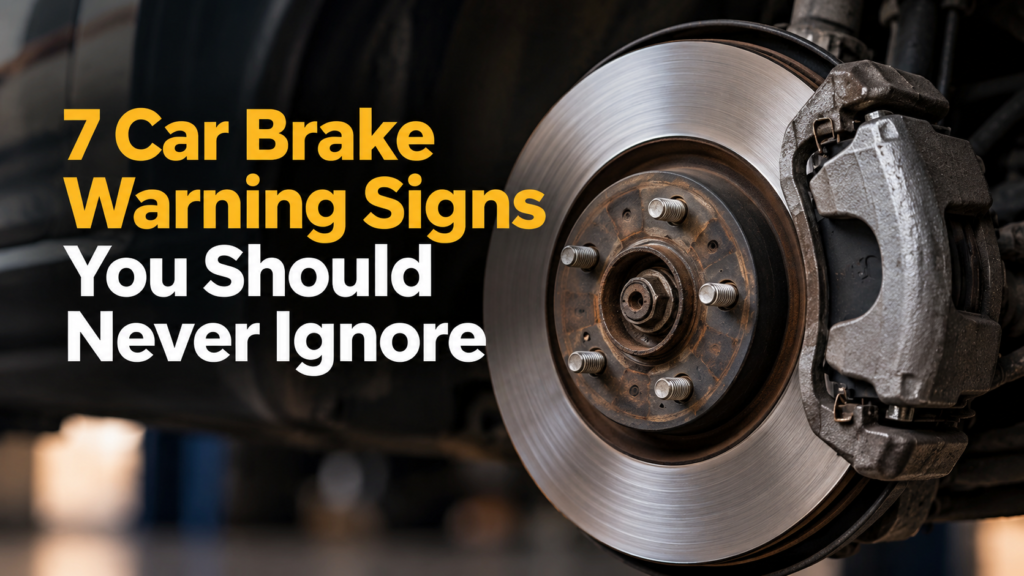
7 Car Brake Warning Signs You Should Never Ignore

Understanding Car Brake Problems and Warning Signs in Bengaluru Car brake warning signs are important to recognise because one of your car’s most important safety features is the braking system, and knowing the warning signs could save your life and save you money while you’re on the road. Other symptoms are squealing noises, vibrations, spongy brake pedal, and more. Since brakes tend to wear out over time, not taking care of these warning signs can lead to problems with braking, particularly in congested urban areas or rainy weather. Here are 7 warning signs of car brakes that you should never ignore.  Why It Is Unsafe to Ignore Your Car Brake Warning Signs in Bengaluru Recognising car brake warning signs early can help prevent expensive repairs and improve road safety. In the city of Bengaluru, there is heavy traffic, stop and go driving, bumpy roads, and the rainy season, which makes having a good braking system crucial. Not addressing any issues related to the brakes will affect you and other drivers negatively. Some of the symptoms that show there might be problems with your brakes include squeaking noises, vibrations, and a soft brake pedal. The problem could be related to your brake pads, brake fluid leak, or ABS. Getting regular checkups for your brakes from Lustro Auto Corp, Sarjapura, Bengaluru, is recommended. 1. Your Brakes Are Squealing or Screeching  A squeal or screeching noise while braking is another typical sign of brake pad replacement needed. Most brake pads contain wear indicator devices that produce these sounds due to worn brake pads. However, sometimes the braking system components can be affected by other factors, such as dust or moisture, causing similar noises. Squeaking once in a while is not always a problem; however, one must never ignore constant noises because worn brake pads may also cause the deterioration of brake discs which results in more expensive repairs. So, if you hear unusual noises while braking, you should have your braking system checked out by a specialist. 2. There Is Grinding While Braking Grinding sound during braking means that the brake pads have been fully worn out and hence the metal backings on the pads are rubbing against the brake discs. This will damage the discs, affect braking efficiency and ultimately result in expensive repairs. Several other brake components may cause grinding sounds and the problem must never be ignored. In case of grinding sounds during braking, stop safely and have a brake inspection done by a professional. 3. Longer Braking Time Slow brake response could be due to brake pad wear, cracked brake disc, low brake fluid or any other brake system problem. This is particularly dangerous in the heavy traffic jams of Bengaluru where you must often brake.  Poor tyres and slick roads may also be a factor in longer stopping distances. Braking issues will generally worsen over time and it is crucial that you identify these issues early.  In case of poor braking, get your vehicle checked by a professional right away.Recognising car brake warning signs early can help you address braking issues before they become more serious. 4. The Brake Pedal is Soft or Spongy An efficient brake pedal is supposed to be sturdy. Whenever you realize that the brake pedal appears to be softer than expected, it could be due to the presence of air in the lines, moisture, insufficient brake fluid or some hydraulic issues. Taking the time to inspect the car when you have such signs can be very helpful in diagnosing and preventing costly future problems. Safety Tip: If the brake pedal feels soft or goes to the floor, pull over to a safe place to have the brakes inspected.  5. Your Car Pulls to One Side  In case you experience towing of the car towards either left or right upon braking, the problem might be due to wear and tear of the brake pads, the brake calliper being seized up or imbalance in brake pressure. Such a situation becomes even more dangerous in the case of heavy traffic situations prevailing on Bengaluru city roads and narrow flyovers. One should take into consideration this problem and get the car checked with an expert mechanic for the cause of the problem. 6. Your Steering Wheel Vibrates When Braking If your steering wheel shakes or vibrates while you brake, it may be due to uneven or damaged front brake discs. This vibration happens because the brake pads fail to maintain even contact with the surface of the disc. Suspension problems or tyre-related issues could also lead to such vibrations. Why is this important? The vibrations could impact the entire braking performance in the future. What should you do? Get a professional mechanic to check the brake system. Changing the brake discs or resurfacing them might be able to resolve the problem.   7. A Brake or ABS Warning Light Appears In modern vehicles, the dashboard lights can warn drivers about the issues with their brakes. The brake indicator can show a low brake fluid problem, while the ABS indicator can notify of the anti-lock brakes issues. Do not ignore these indicators even when your car seems to work normally. You might endanger yourself. How should you act? Ensure your vehicle is properly diagnosed, as this will help to identify the fault and ensure all repairs are made. If the red brake light stays illuminated or if braking becomes different, STOP and seek professional assistance. This is one of the important car brake warning signs that requires prompt attention to help maintain your vehicle’s safety. Why Should You Choose Lustro Autocorp For Car Brake Inspection In Bengaluru? At Lustro Autocorp, Sarjapura, Bengaluru, we offer you professional car servicing and brake inspection services so that you can keep your car safe and in proper condition. Bosch spare parts are used whenever there is a need for a replacement. Our experts assist in detecting all the issues related to your car’s brakes, such as noise and reduced braking efficiency. Conclusion

dashboard warning lights
Car Maintenance Tips

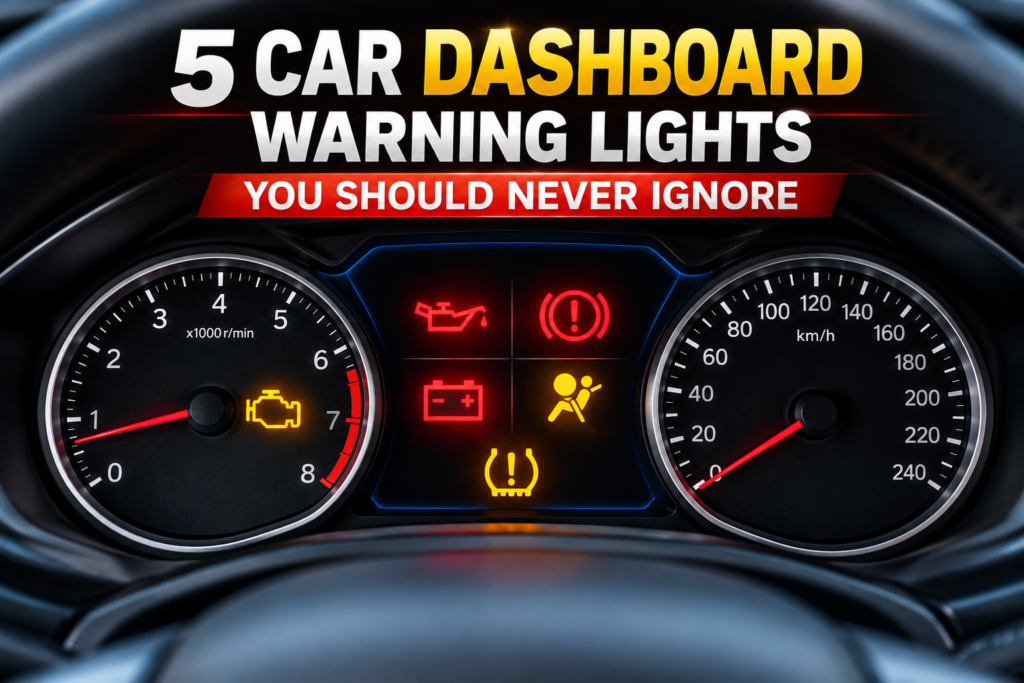
5 Dashboard Warning Lights You Should Never Ignore

The dashboard warning lights in our car do more than simply display lights and symbols. They warn us in advance about issues that may need attention. While some lights simply indicate to us certain information, there are others that tell us about problems that may affect the safety of the car, its performance or damage the engine. Not paying attention to the lights on our dashboard, we run the risk of turning a small problem into a large and expensive repair. Understanding what these key dashboard warning lights mean is very helpful. What Are Dashboard Warning Lights? Dashboard warning lights are designed to inform the driver when there is a potential problem with the vehicle. These lights appear on the dashboard to alert you when your car needs attention.. The lights on the dashboard will signal to the driver when there is an issue with their vehicle. Some examples of car warning lights include check engine light, Engine oil pressure light, brake light, battery light, and airbag light. Dashboard warning lights are designed to inform the driver when there is a potential problem with the vehicle. These lights appear on the dashboard to alert you when your car needs attention. Ignoring these dashboard lights can lead to further damage to your vehicle. It is essential to understand the meaning of these dashboard lights and react immediately if any light appears in your dashboard. The meaning of dashboard indicator lights may be different from one vehicle model to another, so you should always refer to your vehicle’s owner’s manual. Below are five important dashboard warning lights that every car owner should never ignore. 1. Check Engine Warning Light Check engine light is among the most common and vital warning lights found in your car’s dashboard. The check engine light appears in the form of an image similar to an engine. The check engine light may indicate different types of car problems such as a loose fuel cap, a malfunctioning engine, a bad sensor, a catalytic converter, transmission issues or emissions system. Your car may appear to run perfectly even after ignoring this warning sign but neglecting it can cause serious damage and can end up being expensive. If the check engine light comes on, you should have your car diagnosed as soon as possible.  2. Engine oil pressure light The oil pressure warning light resembles an oil can icon and indicates that your engine may be lacking oil pressure and lubrication. Engine oil is essential since it decreases friction between moving parts, keeps the engine cool, and protects the engine’s interior from damages. Some of the causes of low oil pressure include: Low level of engine oil Driving a vehicle without oil pressure can cause severe engine damage or engine failure. In case this warning light illuminates while driving, stop and turn off your engine immediately. If it is safe to do so, check the oil level, but do not continue driving if this warning light is on. 3. Brake Warning Light The brake warning light is one signal that you should never overlook because it is a direct threat to your safety while driving. It may be represented by a circle with an exclamation mark or the word “BRAKE.” There are a number of factors that can cause the brake warning light to come on: It is essential for your safety to have a well-functioning braking system. In case the brake warning light appears while you are driving, it would be wise to take your car to a reliable workshop to avoid any future accidents. 4. Battery Warning Light The presence of the battery warning light indicates a problem with the charging of your vehicle. It could be caused by a dead battery, a faulty alternator, or a disconnected or damaged wiring harness. Ignoring the problem with the charging of your car will lead to the inability of the battery to function properly. Once the battery warning light pops up, you need to have your charging system examined immediately to ensure that your battery is fully charged, and you will not be stranded on the roadside. You can schedule maintenance to ensure that your battery functions well. Your battery will be checked to confirm whether it is fully charged. 5. Airbag Warning Light The airbag light shows an image of someone sitting down in a chair with a circle before him/her. This is caused by such issues as damage to the airbag sensor, damage to the airbag control unit, or a damaged connection to the wire. In case the airbag light turns on in your vehicle, it means that there is a problem with the airbag system in your vehicle. As a result, during the collision, your airbags will not inflate. When this light turns on in your vehicle, you should definitely have your airbag system inspected immediately. To find out more about airbags and vehicle safety, check out the National Highway Traffic Safety Administration (NHTSA). Car warning lights serve the purpose of alerting the driver about some possible problem with his/her vehicle. Some warning lights are more serious than others; however, you should never ignore any warning light which lights up on your dashboard. Never wait until the warning lights on the dashboard become something more serious. Visit Lustro Auto Corp now and take advantage of the Periodic Maintenance Service offered for your car. Conclusion Dashboard warning lights must not be ignored or neglected in any circumstances. These dashboard warning lights are an important part of your car’s communication system and can signal potential problems before they become major issues. Knowing how to identify these warning lights and reacting in time could be essential for maintaining good performance and safety of your car. The warning light on the dashboard might indicate a small issue, but it might also warn you about a more complicated problem with your car. By taking notice of these warnings and getting a proper diagnosis done, you can prevent unwanted car breakdowns and expenses.

Car Maintenance Tips

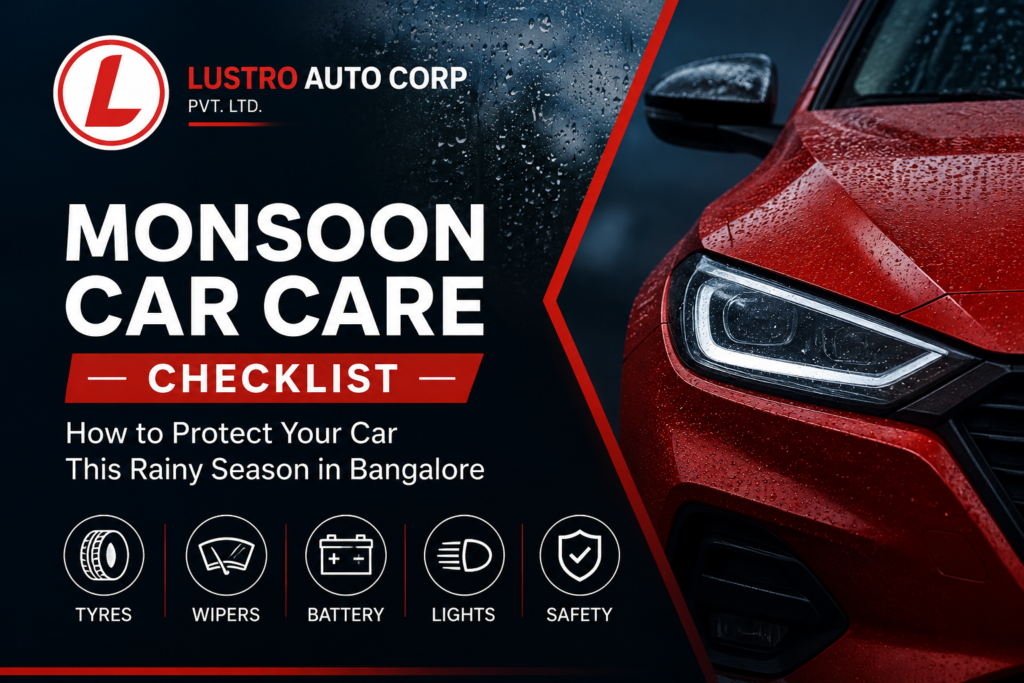
Monsoon Car Care Checklist: How to Protect Your Car This Rainy Season in Bangalore

Monsoon Car Care Checklist: Get Your Car Ready for Bangalore Rains Bangalore’s monsoon brings relief from the heat, but it also puts real stress on your car. Waterlogged roads, sudden downpours, and constant humidity can quietly wear down parts you don’t think about until something goes wrong — usually at the worst possible moment. A little preparation now can save you from breakdowns, safety risks, and expensive repairs later. Here’s a practical monsoon car care checklist to help you get your car ready for the rainy season. 1. Check Your Tyres First Tyres are your car’s only contact with the road, and worn tread dramatically increases the risk of skidding on wet roads. Before the rains set in: Check tread depth — if it’s worn close to the indicator bars, it’s time to replace. Maintain correct tyre pressure (under-inflated tyres reduce grip on wet surfaces). Look for cracks or bulges on the sidewalls. 2. Test Your Wipers and Washer Fluid Poor visibility is one of the biggest causes of monsoon accidents. If your wipers leave streaks or skip patches, replace the blades — they’re inexpensive and make a big difference. Also top up washer fluid so you can quickly clear mud splashes from other vehicles. 3. Inspect Your Brakes Wet roads mean longer stopping distances. Have your brake pads, discs, and fluid levels checked before the season starts. If you’ve noticed any squeaking, grinding, or a soft brake pedal, don’t wait — get it looked at. 4. Protect the Battery and Electricals Humidity and water exposure are hard on your car’s electrical system. Corroded battery terminals or damp wiring can lead to starting issues or sudden electrical faults. A quick battery check and a look at exposed wiring connections can prevent a lot of monsoon breakdowns. 5. Check Headlights and Signal Lights With reduced visibility during heavy rain, working lights aren’t optional — they’re a safety essential. Make sure all headlights, tail lights, and indicators are functioning, and consider cleaning foggy or yellowed headlight covers for better night visibility. 6. Apply Rust Protection to the Underbody Constant exposure to water and mud can accelerate rust, especially on the underside of the car. If you’re driving through waterlogged areas regularly, an underbody wash and anti-rust coating can add years to your car’s structural health. 7. Check AC and Cabin Air Filter Humidity can lead to a musty smell inside the cabin and foggy windows, which is both uncomfortable and a visibility hazard. A clean cabin air filter and a quick AC check help keep the air inside clear and comfortable. 8. Keep an Emergency Kit Ready Even with the best prep, monsoon driving comes with unpredictability. Keep a small emergency kit in your car — a torch, a basic tool set, a phone charger, and your service centre’s contact number. Quick Pre-Monsoon Checklist Check Why It Matters Tyre tread & pressure Prevents skidding on wet roads Wiper blades & washer fluid Maintains visibility in heavy rain Brake pads & fluid Reduces stopping distance risk Battery & wiring Avoids sudden electrical failure Headlights & signals Keeps you visible to others Underbody rust protection Protects against water damage AC & cabin filter Prevents foggy windows & musty air When to Get a Professional Inspection While some of these checks can be done at home, things like brake wear, battery health, and underbody condition are best assessed by a trained technician with the right diagnostic tools. A multi-point check before monsoon sets in is one of the easiest ways to catch small issues before they turn into bigger, more expensive ones. Conclusion Monsoon driving in Bangalore doesn’t have to mean stress and surprise breakdowns. A little preparation — checking your tyres, brakes, wipers, battery, and lights — goes a long way in keeping you safe and your car running smoothly through the season. If you’re not sure where your car currently stands, a quick inspection at a trusted workshop is the easiest way to find out before the rains arrive. Frequently Asked Questions 1. How often should I service my car before monsoon? It’s a good idea to get a check-up at least a few weeks before the monsoon season begins, so there’s time to fix any issues before the rains set in. 2. Is it necessary to change tyres before monsoon? Not always — but if your tread depth is low or you notice cracks on the sidewalls, replacing them before monsoon significantly reduces your risk of skidding. 3. Why does my car smell musty during the rainy season? This is usually caused by moisture buildup in the cabin air filter or AC system. A clean or replaced cabin filter usually resolves it. 4. Can rainwater damage my car’s electrical system? Yes, especially if there’s existing wear on wiring or battery terminals. Regular checks help catch corrosion or exposed connections before they cause a breakdown. 5. What should I do if my car stalls in waterlogged roads? Don’t try to restart the engine immediately — this can cause serious damage if water has entered the engine. Get the car towed to a workshop for inspection instead.

Scroll to Top